The Imperfect Cinematography Of Paul Thomas Anderson
INTRODUCTION
The photography in acclaimed director Paul Thomas Anderson's films feels alive: not because it’s perfect, but because it’s honest. His camera moves with a kind of quiet confidence, gliding through space in long, unbroken takes that observe rather than dictate. Shot on film, often in the anamorphic format, his images carry a texture and depth that mirror the imperfections of real life.
Over the years he’s worked with different DPs, from most of his work which was shot by Robert Elswit, to The Master photographed by Mihai Mălaimare Jr., and his recent collaborations with Michael Bauman. Throughout these different relationships certain stylistic trademarks persist.
In this video, we’ll look at five different techniques that he uses in his films to build emotion not through perfection, but through presence.
1 - LONG TRACKING SHOTS
If you had to narrow down all the filmmakers which influenced Paul Thomas Anderon’s approach into a single director, especially in his earlier work, it would be Robert Altman.

“I think what happens is that it’s in my DNA. It’s that I grew up watching those movies. It’s just informed me and informed how I want to tell stories. I learned from that and hopefully can bring something new.”
One of the visual traits of both directors is not overly chopping up their edits with quick cuts to multiple shots and angles, but rather filming more considered master shots, which often track the actions of a character, and letting those breathe in drawn out takes.
More often than not they keep their films dynamic, like their characters to be moving and for the camera to track that movement by following them.
Whereas Altman would often create frame movement by zooming the lens, Paul Thomas Anderson and his team usually used two different tools to film these long tracking shots: either a Steadicam or a dolly and lots of track.

A Steadicam mounts the camera directly to an operator via a vest with an arm and a gimbal-like stabilisation system. It gives footage a smooth, floating, fluid motion and allows the camera to move anywhere that a person is able to walk.
He’s used this for long takes, where the camera navigates through doorways, turns corners, or moves around various characters.
Because Steadicams are strapped directly onto the body the movement can come with little bumps, vibrations and small imperfections. Rather than removing these imperfections from his recent work with post production stabilisation software, he opts to keep it in. This makes the camera language feel alive, living and breathing, with a subtle handmade quality to it - something which is felt in most of his work.
Sometimes he’ll play out large portions of scenes in one, long Steadicam take. Or combine it with another technique like a crane step off, where the Steadicam op, starts on a crane platform, which then jibs down to the ground, and gives them a chance to step off the platform and continue with the rest of the take on foot.
Dolly movement on the other hand tends to be a bit smoother. A dolly is a heavy camera platform with wheels which can be pushed along tracks. Unlike a Steadicam, which can move anywhere that the operator can walk, a dolly on tracks usually sticks to one straight axis of movement.

Although there are also curved dolly tracks for doing a circular or semi circular movement.
PTA’s dolly tracking shots often follow characters as they walk or run, alongside a straight line of track.
For more stationary scenes when characters are seated he’s also used a dolly to do push ins on them, moving closer and getting inside their heads.
2 - FILM FORMATS
One thread that runs through all the movies that he’s directed is that they have all been shot on film, rather than digital cinema cameras.

Of the 10 feature films he’s made, 6 were made with a widescreen aspect ratio, while the remaining 4 used a taller frame. The size of the frame that he uses to present these worlds on screen has shifted over time, with his first 5 movies using a 2.39:1 aspect ratio, and most of his later work presented in 1.85:1.

Not only is he fond of the widescreen aspect ratio, but more specifically he likes shooting in the 4-perf 35mm anamorphic format with C and E-series Panavision anamorphic lenses.
These lenses squeeze the image horizontally by a factor of 2 to fit each frame onto a piece of film that is 4 perforations tall. This creates a higher resolution but distorted frame. This image is later desqueezed by a factor of 2 to get it back to its original proportions, which gives it its widescreen aspect ratio.

This anamorphic format also comes with additional characteristics, like more stretched, oval shaped bokeh, horizontal flares which the vintage Panavision lenses render in blue, and more distortion and focus falloff around the edges of the frame.
On the other hand much of his more recent work uses spherical lenses and either the Super 35 format, large format 5-perf 65mm film (in The Master), or 35mm VistaVision on his most recent One Battle After Another.
Spherical lenses create footage without an exaggerated squeeze factor, which renders images more truly, with less distortion, rounded bokeh and a squarer frame.
3 - INTIMATE FRAMING
One of the most distinctive aspects of Paul Thomas Anderson’s cinematography is how he shifts between observational wides and intimate close ups within a single sequence. His wide shots often feel detached, almost documentary-like.
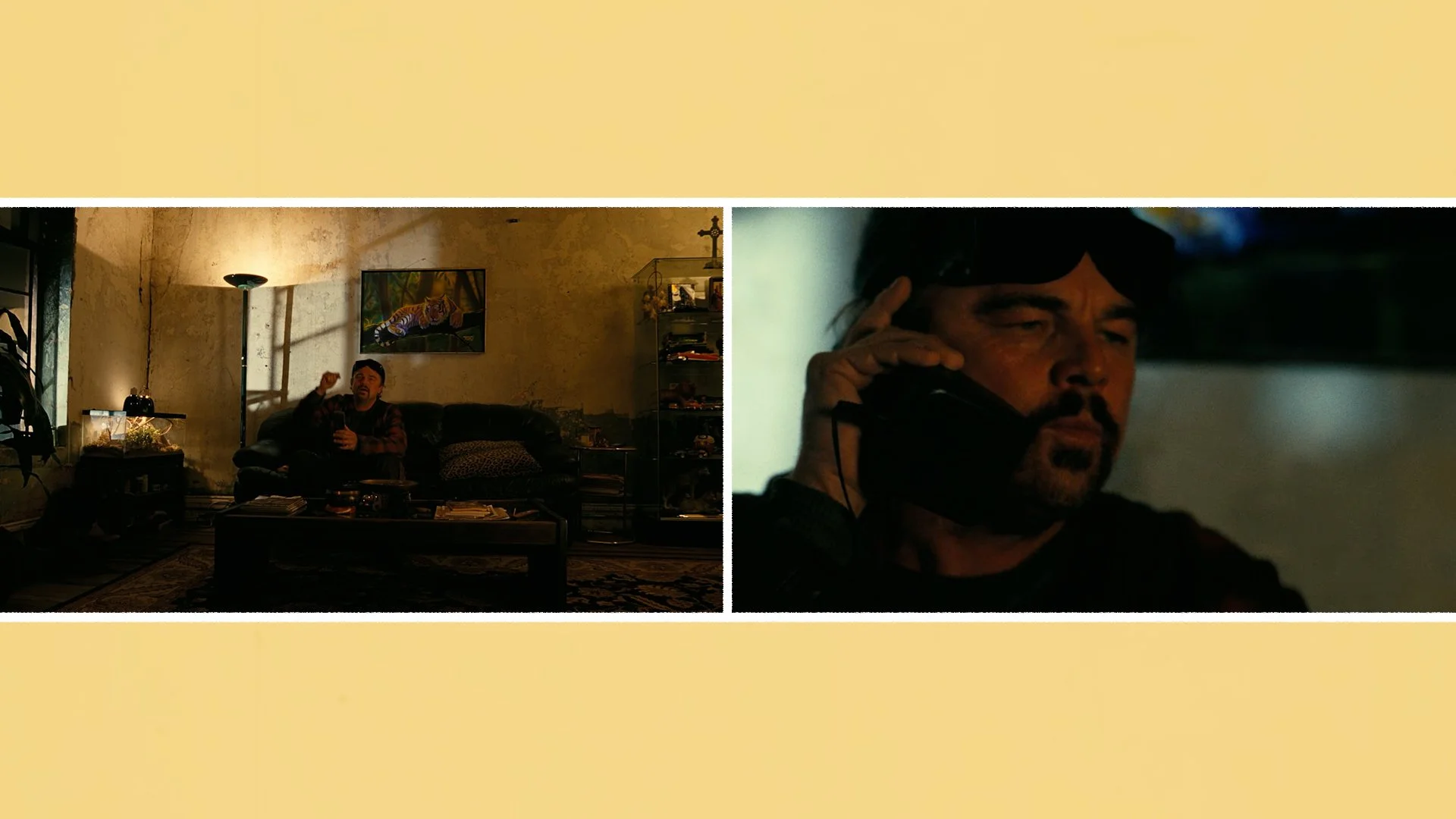
When shooting in the anamorphic format he’ll often use a wider focal length for this, like a 40mm anamorphic lens, that bends the edges of the frame with distortion. This allows the viewer to observe characters in their environment to see how they occupy space and how that space defines them. But when the emotion of a scene peaks, Anderson moves in close, often with a slightly more telephoto lens, such as a 75mm, letting faces fill the frame and gestures carry weight.
This push and pull between distance and closeness reflects the emotional rhythms of his storytelling. A wide shot might hold a moment in tension, giving characters room to breathe, while a sudden close-up collapses that space, drawing us directly into their internal world.

In The Master, for instance, the switch between wide compositions, which even includes a fisheye lens shot, and tight, centered portraits of the characters, some of which were shot on a 300mm telephoto lens, creates an almost hypnotic intimacy.
4 - NATURAL, IMPERFECT LIGHTING
Paul Thomas Anderson’s approach to lighting has always leaned toward naturalism and imperfection. He’s comfortable letting the highlights from windows or even in daylight exteriors blow out, for practical bulbs to clip, and the shadows to fall away into darkness. This goes against the conventions of trying to preserve the dynamic range of what the camera captures to maintain detail in both the shadows and highlights.

Like the little vibrations and bumps in camera motion, this lighting philosophy gives his films a tactile, lived-in quality - like the images haven’t been overworked or overconstructed.
Working with cinematographers like Robert Elswit, Anderson often lights scenes using available or practical light sources like windows, candles, photographic lights, or table lamps, enhancing them subtly rather than replacing them with totally artificial setups.

Early in his career, Anderson and Elswit frequently used hard light, perhaps inspired again by some of those Robert Altman movies he grew up watching. You can see hard shadows from actors cast against walls.
Another aspect of imperfection comes from the occasional lapse in lighting continuity between shots. In There Will Be Blood, the famous oil fire sequence transitions between shots at night which were filmed after sunset lit by flames, to later shots filmed at dusk with a blue sky. There’s a similar lapse in continuity in a chase scene in his most recent work. Rather than being a negative, it’s another one of those little imperfections which gives the film its hand constructed feeling, by focusing on the chaos in the story rather than technical perfection.
5 - PRACTICAL FILMING
One of the most important visual aspects that gives his films their scope and sense of reality, is that he pretty much only uses real world, practical locations. He never builds sets on soundstages, well, unless the location in the script is a soundstage.

He also favors in-camera effects and practical setups over CGI, grounding even the most cinematic moments in reality. From that oil fire that we already mentioned which was shot with real flames erupting from a full-scale rig, to car crashes, stunts or confrontations. By capturing things for real, they feel real.
This preference for the tangible gives his images a sense of weight. Explosions, accidents, and even simple moments like a curtain billowing or dust hanging in the air are real phenomena happening in front of the lens. Combined with his other photographic techniques, it results in an image that feels textured, imperfect, and human - that can’t quite be replicated through digital trickery.
CONCLUSION
Paul Thomas Anderson’s cinematography is a study in controlled imperfection. His long, fluid camera moves, choice to shoot on film, clipping natural light, and his preference for practical locations and effects all point toward the same idea: that truth in cinema doesn’t come from precision, but from presence.
He builds emotion not by polishing every frame, but by allowing each one to breathe. In a time where so much of filmmaking is about control, Anderson’s images remind us that, just like in the work of his cinematic influences, beauty often lies in what’s unpredictable, fleeting, and imperfect.